Fiery sunsets
Wonderful views

Let yourself be embraced by the warmth of Calabria, where every glance stirs emotion, every encounter feels like a hug, and beauty surprises you at every step.
CALABRIA
O N T H E R O A D
CALABRIA
RoadCalabria
O N T H E R O A D
Italy's most authentic region!
ROADCALABRIA
CONTACTS
EXPLORE
Ideas, itineraries and places to discover, to experience Calabria on the road
Aragonese Castle of Reggio Calabria: history and charm of a thousand-year-old fortress
Follow us on Instagram
Home
Itineraries
info@roadcalabria.it
Villages
What you’re looking for
CALABRIA
O N T H E R O A D
Beaches
Did you know that
A journey through ancient dominions, medieval towers and striking views over the Strait
Art, History, Culture
Useful Links
National Parks
Write to us
Trekking
Some of the images on RoadCalabria come from the 'Calabria Straordinaria' portal of the Calabria Region and are used under a CC-BY license
© 2026 RoadCalabria
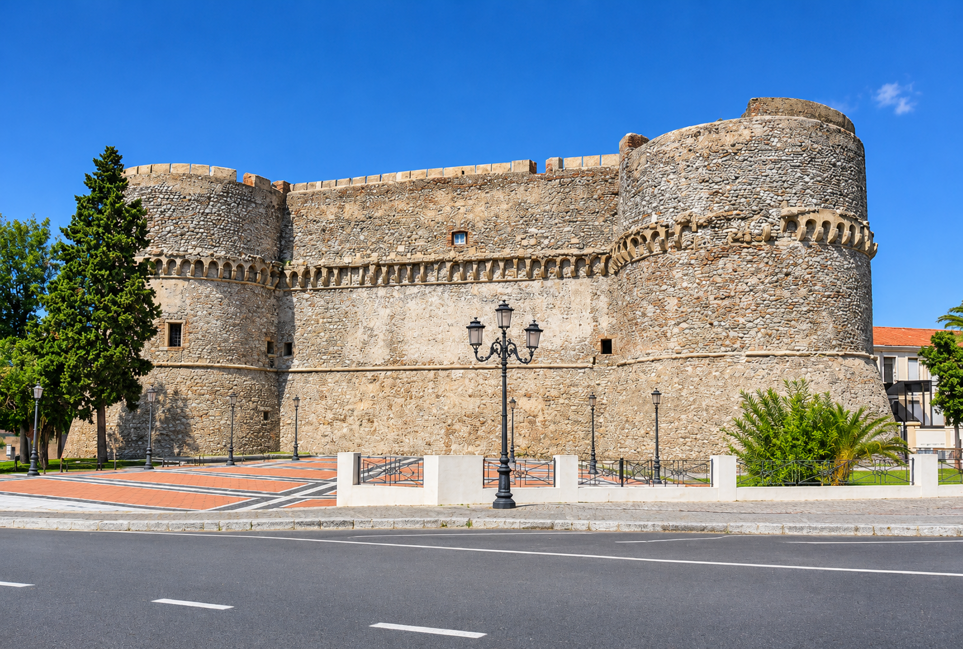
In the heart of Reggio Calabria, among the streets of the historic center and just a short walk from the city’s main attractions, rises one of the city’s most iconic monuments: the Aragonese Castle, a fortress that preserves centuries of history, architectural transformations, and events that have profoundly shaped the Calabrian territory.
With its two imposing crenellated circular towers, the castle is one of the most important witnesses to Reggio Calabria’s medieval past. Its walls tell a story of conquests, sieges, foreign rule, and major changes, offering visitors the chance to discover a side of the city that goes well beyond the famous Lungomare Falcomatà and the Riace Bronzes.
Today, after major restoration and enhancement work, the Aragonese Castle has also become a lively cultural venue, hosting exhibitions, displays, and events, confirming itself as a must-see stop for anyone wishing to discover the history and artistic heritage of Reggio Calabria.
The origins of the Aragonese Castle: a history older than its name
Although it is known as the Aragonese Castle, the origins of the fortress are much older than Aragonese rule.
The hill on which the castle stands already held, in Greek times, a strategic position for the city's defense. Its location in fact made it possible to control an important part of the settlement and the access routes, making this place particularly suitable for the construction of fortified structures.
The first fortifications are traditionally traced back to the Byzantine era, when Reggio Calabria played a key role in the political and military system of southern Italy.
Some historical reconstructions place the birth of the first defensive core between the 6th and the 11th century, while the layout of the medieval castle is generally linked to the later transformations of the Norman and Swabian periods.
The fortress thus began as a military outpost, meant to protect the city and to ensure control of a territory of particular importance for its position on the Strait of Messina.
After the initial Byzantine period, the fortress came under Norman control, who strengthened their rule over southern Italy during the 11th century.
Later the Swabians worked on the structure, probably helping to create the large quadrangular fortified complex, marked by four corner towers and massive defensive walls.
With the arrival of the Angevins, in the second half of the 13th century, the castle continued to play a strategic role.
During this phase further fortification works were carried out, including external defense systems and protected walkways.
But it was above all under Aragonese rule, and in particular under Ferdinand I of Aragon, that the fortress took on the appearance that still today makes it immediately recognizable. It is to this phase that the construction of the two large crenellated cylindrical towers dates, which over time have become the symbol of the monument.
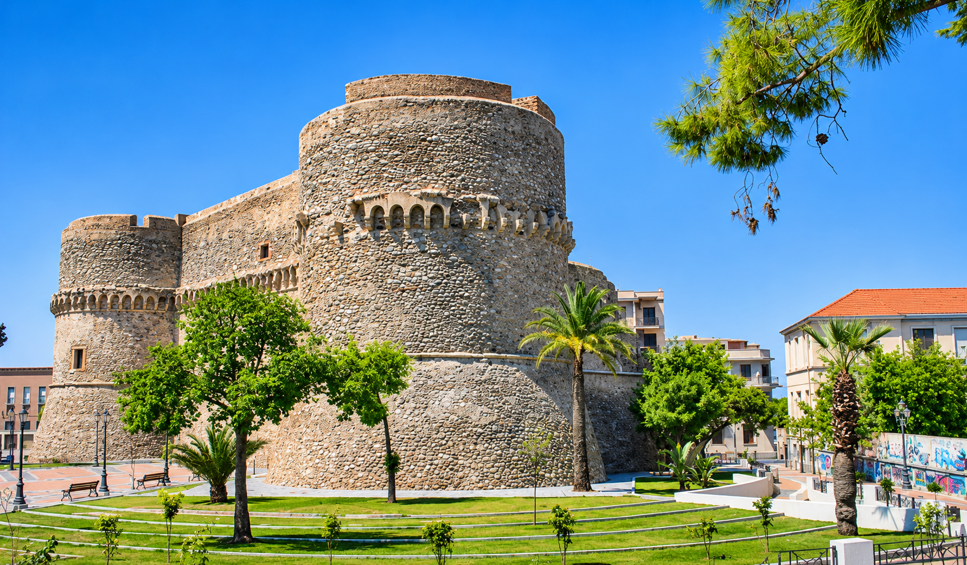
The two Aragonese towers: the symbol of the castle
Looking at the Aragonese Castle from the square in front, what immediately stands out is the presence of its two mighty circular towers. These structures are the most recognizable part of the fortress and are a valuable testimony to fifteenth-century military architecture in the south of Italy.
The towers were designed to strengthen the castle’s defensive capacity, in a period when medieval fortifications had to adapt to the growing power of artillery. Their cylindrical shape allowed greater resistance to impacts than traditional square towers, while the defensive openings made it possible to monitor and protect the surrounding areas.
The two towers are linked by a stretch of curtain wall, marked by architectural elements that help make the monument’s exterior especially striking.
Among these stand out the pointed arches and the battlements that crown the structure, recalling the image of the great medieval fortresses.
In 1897, precisely for their historical and architectural value, the towers of the Aragonese Castle were recognized as an Italian National Monument.
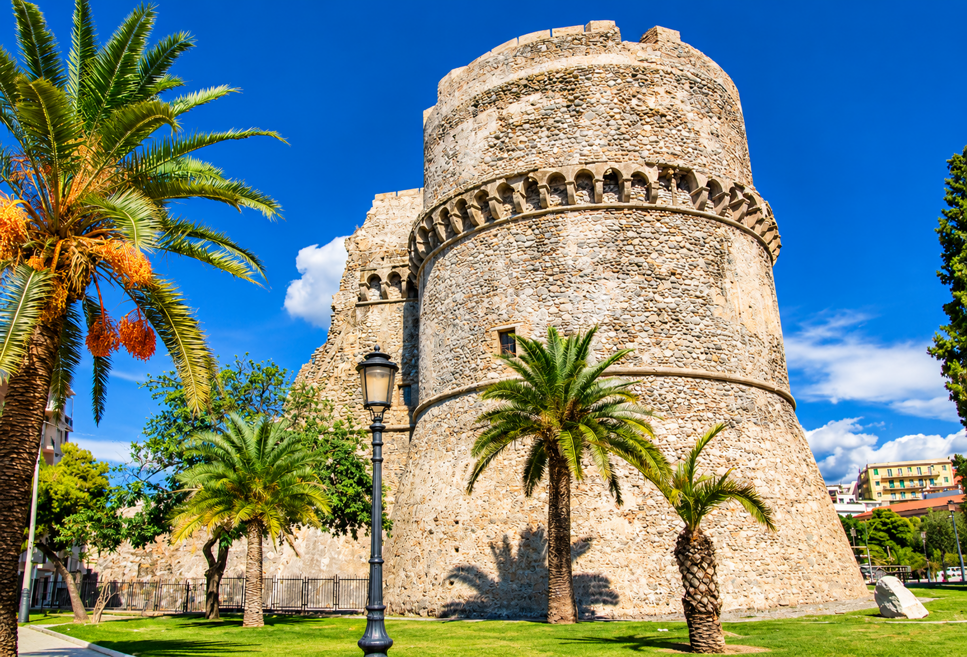
The 1908 earthquake and the loss of much of the fortress
One of the events that most influenced the present-day appearance of the Aragonese Castle was the devastating earthquake of 28 December 1908. The quake, which struck Reggio Calabria and Messina hard, caused enormous destruction and forever changed the urban face of the two cities on the Strait.
The castle also suffered damage, but the loss of much of the ancient structure was not due solely to the earthquake.
Already during the nineteenth century, proposals had been put forward to demolish and transform the area, linked to the city's new urban plans.
After the quake, further works led to the demolition of large portions of the fortress, also to allow the opening and connection of new roads. Of the original great fortified complex, above all the two Aragonese towers and the stretch of wall that joins them survived. What we can admire today therefore represents only a part of the ancient castle, a precious fragment of a building that once occupied a much larger area.
This very survival makes the monument particularly significant: its walls are one of the clearest links between medieval Reggio and the modern city.
The Aragonese Castle today: from military fortress to cultural center
After centuries of transformations, the Aragonese Castle has entered a new phase thanks to restoration and enhancement works. The recovery of the interior spaces and the redevelopment of the nearby Piazza Castello have given the city back a place of great historical and cultural interest.
Today the fortress hosts temporary exhibitions, art displays, meetings and cultural events, becoming a place for gathering and for enhancing the city's heritage. The restored rooms allow visitors to observe up close some elements of the defensive structure, while the internal routes offer a different perspective on the monument's architecture.
Especially evocative is the chance, when permitted, to reach the upper terraces, from which you can admire panoramic views of the city and the Strait of Messina.
The castle is therefore not only a monument to be seen from the outside, but a place to experience and discover through the initiatives that are periodically organized inside it.
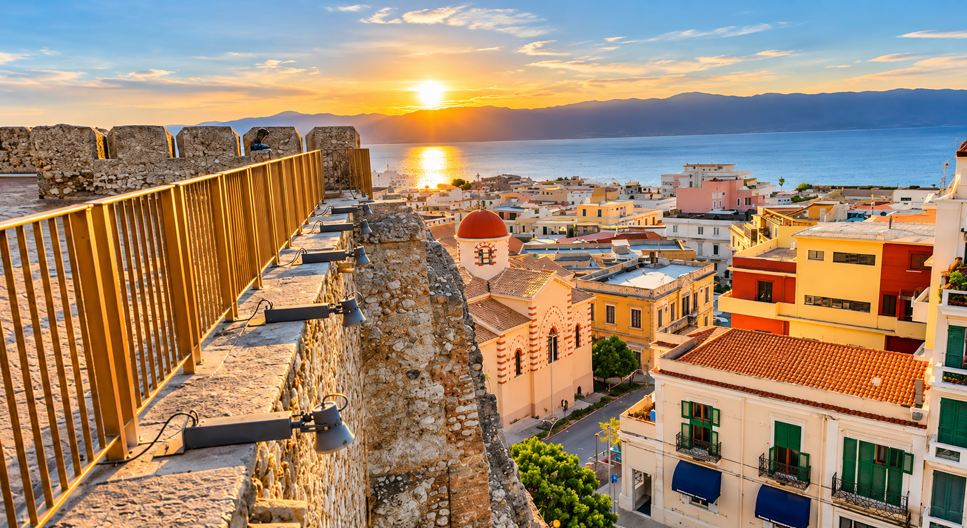
The Aragonese Castle: a symbol of Reggio Calabria’s history
Among the monuments that tell the identity of Reggio Calabria, the Aragonese Castle holds a special place.
Its towers, which have survived centuries of wars, rule, earthquakes and urban transformations, stand as tangible proof of the city’s long and complex history.
Today the fortress has left behind its ancient defensive role to become a space open to culture, art and participation. A change that shows how historic heritage can keep living on, taking on new meanings without losing its link to the past.
Visiting the Aragonese Castle means discovering an ancient and fascinating Reggio Calabria, where every stone tells a fragment of history and where the past keeps dialoguing with the present.
A stop not to be missed during a trip to discover the city of the Strait and its extraordinary cultural riches.
In the surroundings of Reggio Calabria
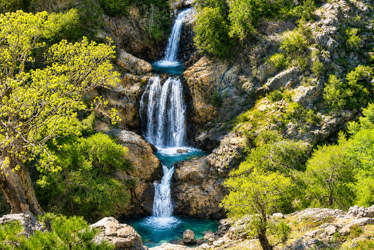

ASPROMONTE NATIONAL PARK
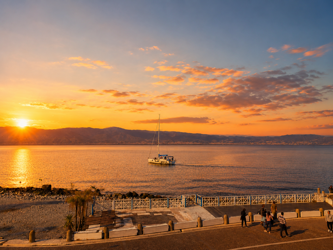
STRAIT OF MESSINA
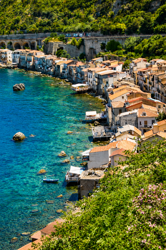
SCILLA
PENTEDATTILO