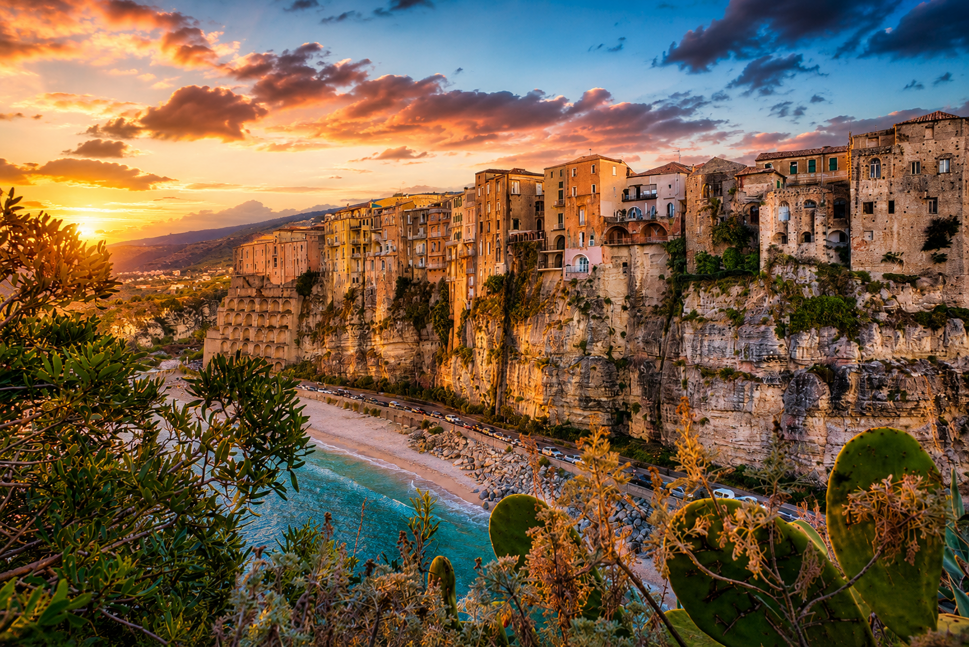
Fiery sunsets
Wonderful views

Let yourself be embraced by the warmth of Calabria, where every glance stirs emotion, every encounter feels like a hug, and beauty surprises you at every step.
CALABRIA
O N T H E R O A D
CALABRIA
RoadCalabria
O N T H E R O A D
Italy's most authentic region!
ROADCALABRIA
CONTACTS
EXPLORE
Ideas, itineraries and places to discover, to experience Calabria on the road
Murat Castle in Pizzo: the fortress where Joachim Murat was killed
Follow us on Instagram
Home
Itineraries
info@roadcalabria.it
Villages
What you’re looking for
CALABRIA
O N T H E R O A D
Beaches
Did you know that
A landmark place in Pizzo, one of the most evocative spots on the Coast of the Gods
Art, History, Culture
Useful Links
National Parks
Write to us
Trekking
Some of the images on RoadCalabria come from the 'Calabria Straordinaria' portal of the Calabria Region and are used under a CC-BY license
© 2026 RoadCalabria
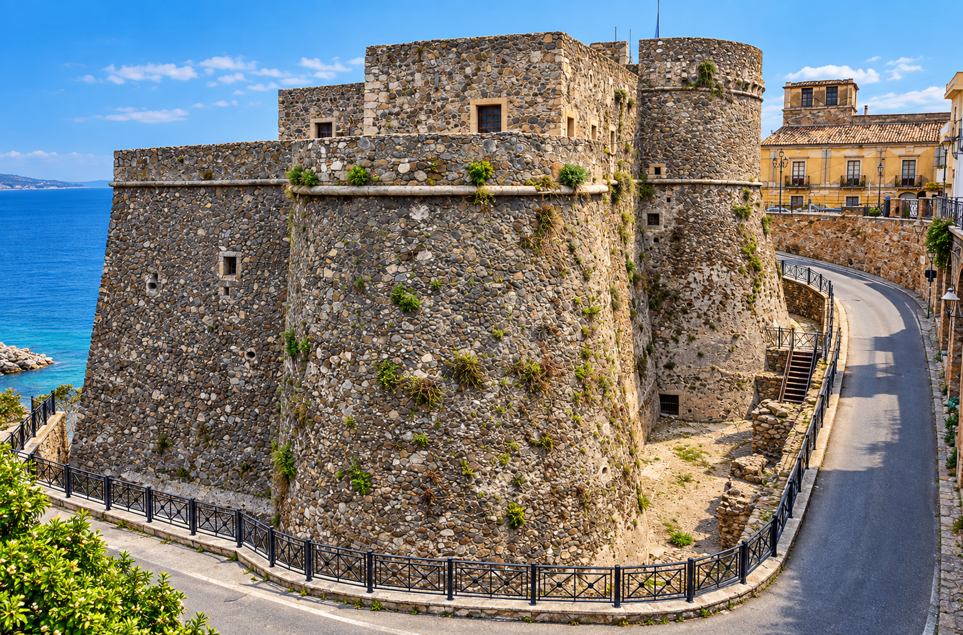
Overlooking the Gulf of Sant’Eufemia, in the heart of the historic center of Pizzo, Murat Castle is one of the most evocative places on the Coast of the Gods and one of Calabria’s best-known fortresses. Its walls dominate the sea from a prime position, but what made it famous above all is the story of Gioacchino Murat, King of Naples and Napoleon Bonaparte’s brother-in-law, who spent the last days of his life here before being shot on 13 October 1815.
Visiting the castle therefore means stepping into a place where views and history intertwine: from the ancient defensive structures to the rooms dedicated to Murat, all the way to the glimpses of the Tyrrhenian Sea that accompany much of the visit.
The origins of Pizzo Castle
The history of the fortress is far older than that of Joachim Murat. Its original core dates back to the 14th century, when the Torre Mastia was built, a large watchtower meant to control the stretch of coast and to protect the area from raids coming from the sea.
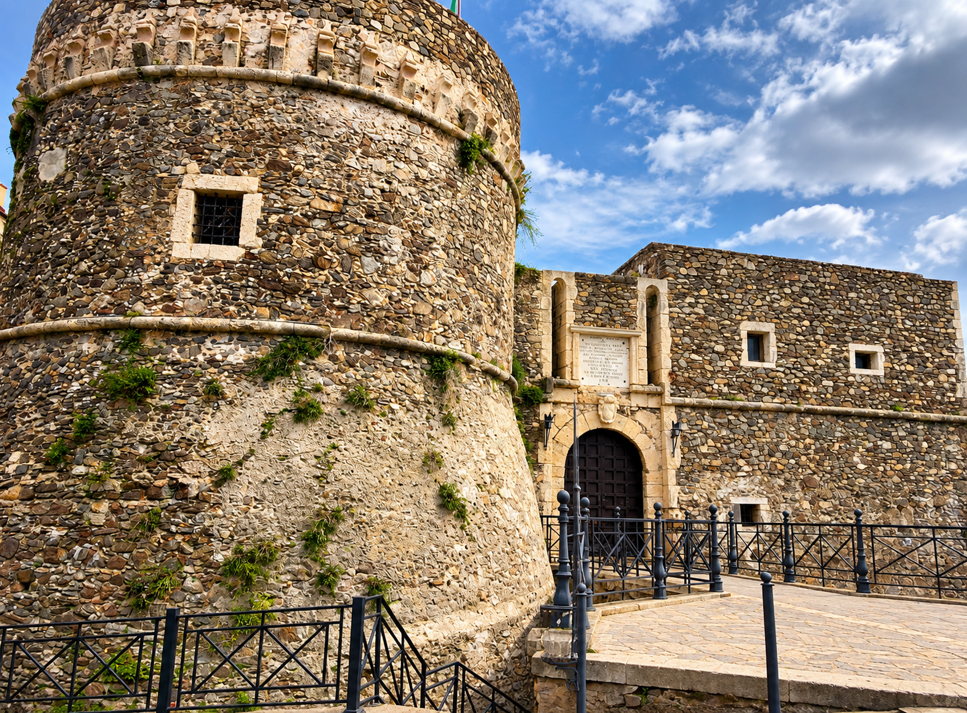
In the 15th century, during Aragonese rule, the defensive system was strengthened. Ferdinand I of Aragon ordered in 1480 the reinforcement of the fortification: to the pre-existing structure were added walls, a central body and further defensive elements. The castle thus took on much of the appearance that still defines it today, with the imposing complex overlooking the sea and protected on the inland side by a moat.
The fortress was also damaged by the violent earthquake of 1783, which destroyed part of the upper rooms, later rebuilt. Over the course of the 19th century the castle was also used as a barracks and prison and in 1892 it was declared a National Monument.
Joachim Murat and the Castle of Pizzo
The castle’s name is inseparably linked to Joachim Murat, Marshal of France, Napoleon Bonaparte’s brother-in-law and King of Naples from 1808.
After Napoleon’s fall and the loss of the throne, Murat took refuge in Corsica. Convinced he could win back the Kingdom of Naples, in September 1815 he set out with a small contingent of men. His plan initially called for a landing farther north, but the circumstances of the voyage brought him to the Calabrian coast. On 8 October 1815 Murat landed at Pizzo, hoping to gather support and spark an uprising against the Bourbons.
The attempt failed almost at once. Murat was captured by the Bourbon gendarmerie and taken inside the castle itself, which would become the stage for the last days of his life.
On 13 October 1815, just five days after his landing at Pizzo, the former King of Naples was shot inside the fortress. Before the execution he wrote a final letter to his wife Caroline Bonaparte and their children, received religious comfort and faced the firing squad, refusing to be blindfolded.
His death forever changed the castle’s identity. From a simple Aragonese stronghold, the manor became one of the main places of memory tied to the Napoleonic epic in Southern Italy.
What to see in Murat Castle
The interior rooms allow visitors to retrace Gioacchino Murat’s last days through a museum reconstruction. The route leads to the places of imprisonment and to the spaces linked to the trial, the confession, and the former ruler’s final moments.
Especially evocative is the secret chamber identified as Murat’s cell. The castle also preserves plaques and accounts connected to the Murat affair and houses a numismatic collection devoted to some of the main historical phases of southern Italy.
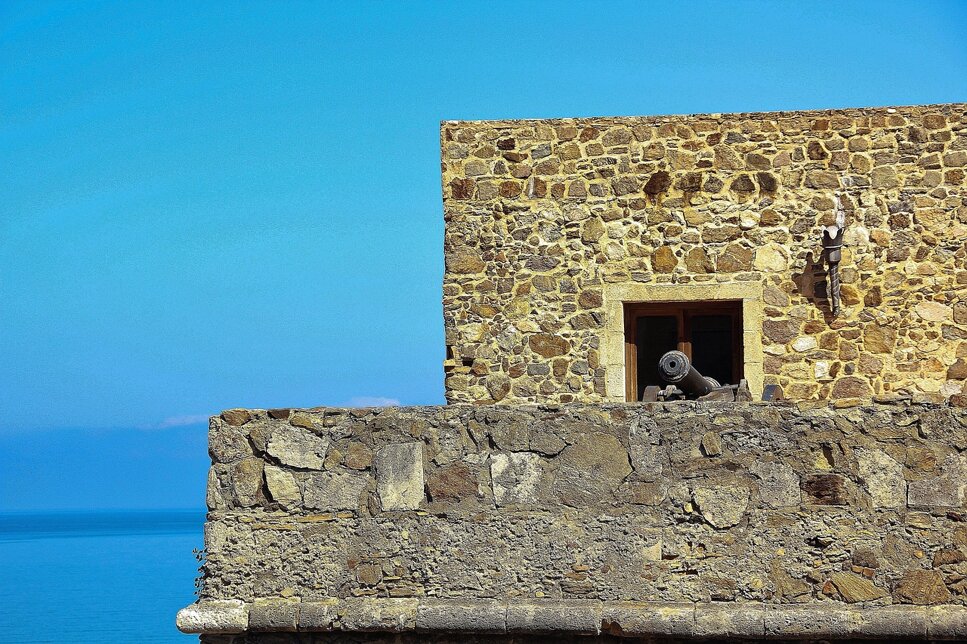
The visit also makes it possible to closely observe the fortress’s military architecture: the massive stone walls, the towers, the interior rooms, and the structures that recall the complex’s original defensive function.
The view of the Coast of the Gods
One of the reasons to visit Murat Castle is certainly its panoramic location.
The fortress stands on the cliff of Pizzo and overlooks the Gulf of Sant'Eufemia and is the gateway to the Coast of the Gods, offering wide views over the Tyrrhenian Sea. The Ministry of Culture describes the panoramic setting as one of the distinctive features of the castle and the town.
The contrast between the ancient stone walls, the historic center and the blue of the sea makes this area especially evocative, above all on clear days and in the hours before sunset.
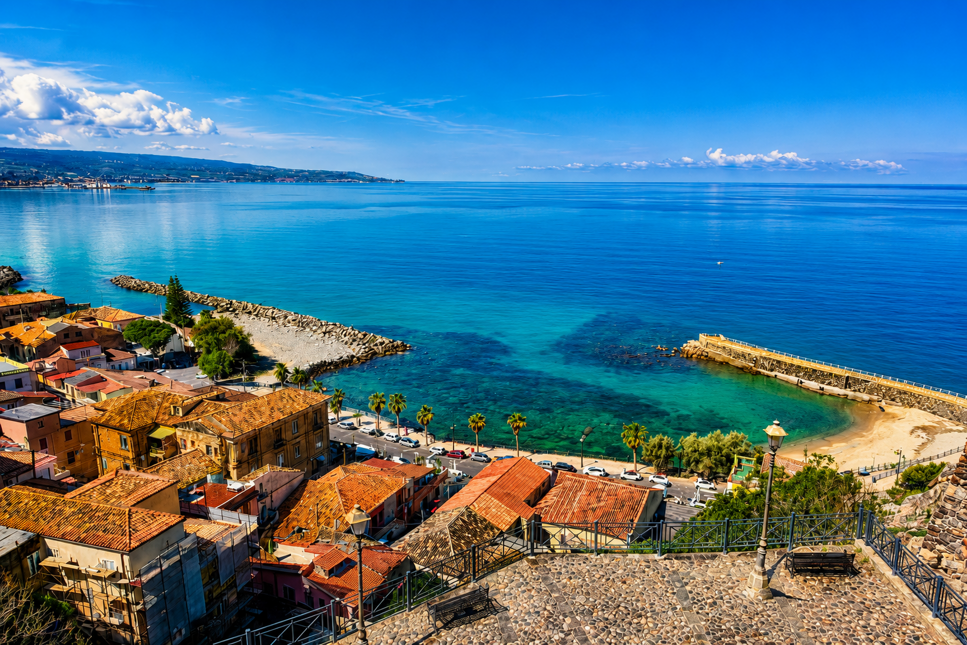
The Castle and the historic center of Pizzo
A visit to Murat Castle fits perfectly into a walk through the historic center of Pizzo. The fortress is in fact located in the heart of the town and makes it easy to reach squares, alleys and panoramic terraces.
It is worth continuing on to Piazza della Repubblica, the heart of town life, and reaching the Church of San Giorgio Martire, closely linked to Murat’s story: after the firing squad, the ruler was buried right in the church, in a mass grave.
Pizzo is also one of the best-known places on the Costa degli Dei and the visit can be rounded off with a stroll along the seafront and, of course, a taste of the famous Tartufo di Pizzo.
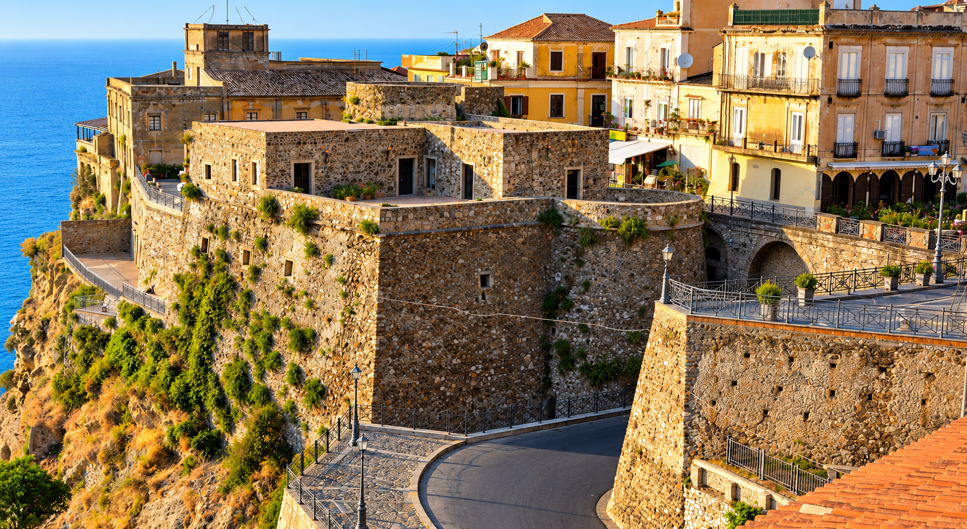
In the surroundings of the Castle
PIEDIGROTTA
TROPEA
CAPO VATICANO
VIBO VALENTIA
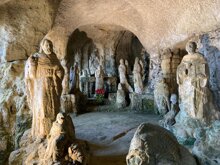
After visiting Murat Castle, it is well worth taking some time to explore Pizzo, strolling through the narrow streets of its historic centre, Piazza della Repubblica and the panoramic terraces overlooking the sea. Just outside the town centre lies the fascinating Church of Piedigrotta, carved into the rock just a few steps from the beach and famous for its numerous statues sculpted from tuff stone.
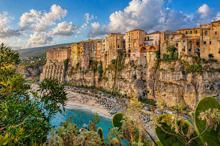
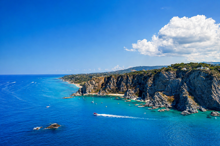
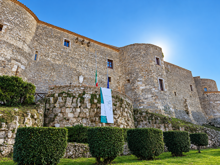
Pizzo is also an excellent starting point for exploring the Coast of the Gods. Heading south, you can reach Tropea, with its spectacular historic centre perched on a cliff, and Capo Vaticano, renowned for its dramatic cliffs, secluded coves and crystal-clear waters. Inland, Vibo Valentia is also well worth a visit, where the impressive Norman-Swabian Castle now houses the “Vito Capialbi” National Archaeological Museum.
Discover these weekend itineraries!