Fiery sunsets
Wonderful views

Let yourself be embraced by the warmth of Calabria, where every glance stirs emotion, every encounter feels like a hug, and beauty surprises you at every step.
CALABRIA
O N T H E R O A D
CALABRIA
RoadCalabria
O N T H E R O A D
Italy's most authentic region!
ROADCALABRIA
CONTACTS
EXPLORE
Ideas, itineraries and places to discover, to experience Calabria on the road
MuSaBa - Santa Barbara Museum Park: contemporary art museum, open-air park and art workshop at the foot of the Aspromonte
Follow us on Instagram
Home
Itineraries
info@roadcalabria.it
Villages
What you’re looking for
CALABRIA
O N T H E R O A D
Beaches
Did you know that
Art, History, Culture
Useful Links
National Parks
Write to us
Workshop of boundless creative freedom. The result of the visionary genius of Nik Spatari.
Trekking
Some of the images on RoadCalabria come from the 'Calabria Straordinaria' portal of the Calabria Region and are used under a CC-BY license
© 2026 RoadCalabria
Some places are hard to fit into a precise category. MuSaBa in Mammola is one of them.
Contemporary art museum, open-air park, art workshop, architecture and landscape blend into a single, super-colorful space at the foot of the Aspromonte, built around the remains of an ancient monastic complex.
The name MuSaBa comes from Museo Santa Barbara and the project is the result of a lifetime’s work by Nik Spatari and Hiske Maas, an artist couple who, at the end of the Sixties, chose this corner of Calabria to shape a project truly outside the box.
Today MuSaBa is one of the most original places to visit in Calabria: seven hectares of art, mosaics, architecture and monumental installations immersed in nature.
Where MuSaBa is located
MuSaBa is located in the area of Mammola, in the province of Reggio Calabria, in the Locride and at the foot of the Aspromonte. The museum is not in the town center, but along Viale Parco Museo Santa Barbara, set in the valley landscape.
The location is also interesting for those exploring the Ionian coast: MuSaBa can be easily included in an inland Locride itinerary, pairing it with a visit to Mammola, Gerace, or the other villages in the area.
The history of MuSaBa
The museum’s history is closely tied to that of Nik Spatari, an artist born right in Mammola in 1929, and his Dutch partner Hiske Maas.
Spatari had a decidedly unusual background. He gradually lost his hearing while still a child and developed a particularly intense relationship with drawing and the visual arts. After several artistic experiences away from Calabria, at the end of the Sixties he returned to his homeland together with Hiske Maas.
In 1969 the two began restoring a complex now in ruins in the Santa Barbara valley.
What at first might have seemed an almost impossible project gradually turned into something much bigger: not a traditional museum in which to gather works made elsewhere, but a place where artists could live, work and create works conceived specifically for this area.
The first efforts were devoted to cleaning and recovering the ruins. Between 1971 and 1973 the first exhibition space was created, and from 1974 the real artistic activities began, with works also coming from the Milanese art scene.
Since then MuSaBa has continued to grow.
A completely different museum
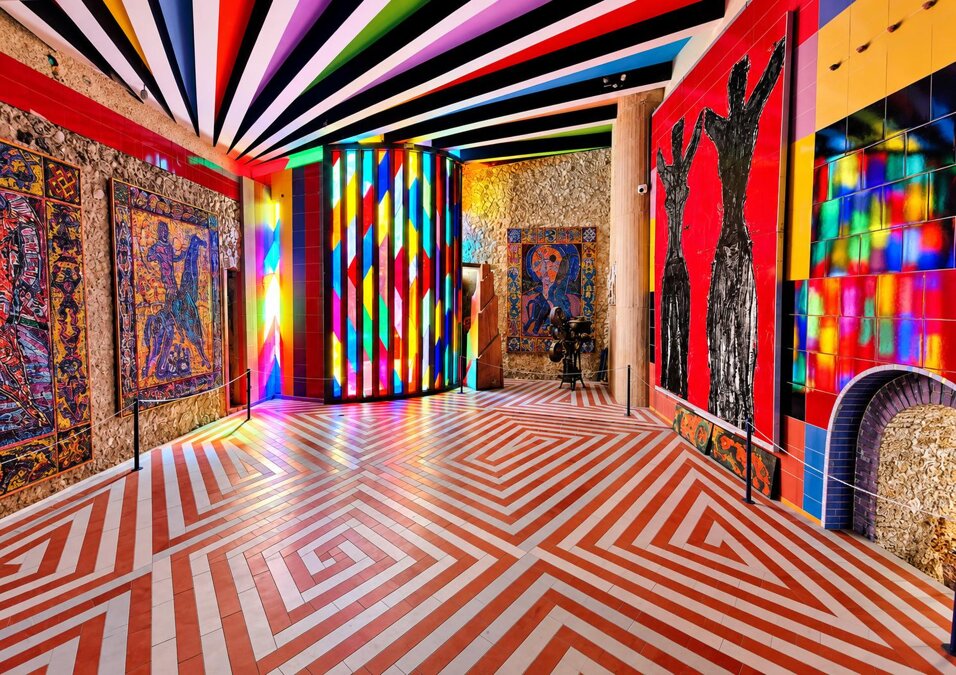
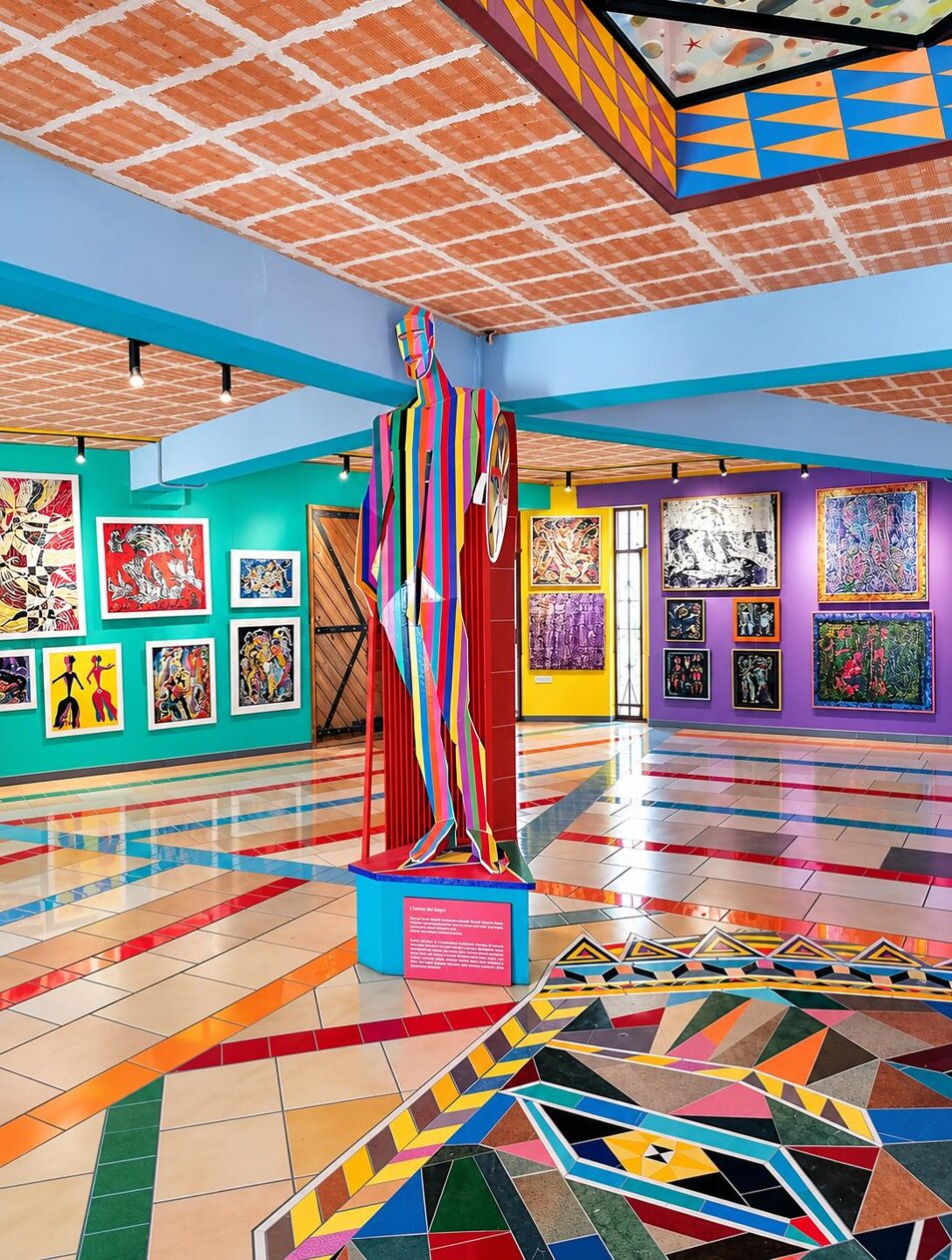
Forget the classic idea of a museum made of corridors, display cases and white rooms. At MuSaBa, art is practically everywhere. It appears on walls, on floors and on the architecture. You come across it while walking in the greenery, and it blends with the remains of the ancient Santa Barbara complex.
Over the years artists, students and volunteers from different countries have taken part in transforming the place, creating site-specific works and interventions.
The result is deliberately surprising: ancient ruins, brightly colored mosaics, large sculptures and contemporary architecture coexist in the same landscape.
More than entering a museum, you get the feeling of stepping into the personal universe built by Nik Spatari over more than fifty years.
Jacob's dream
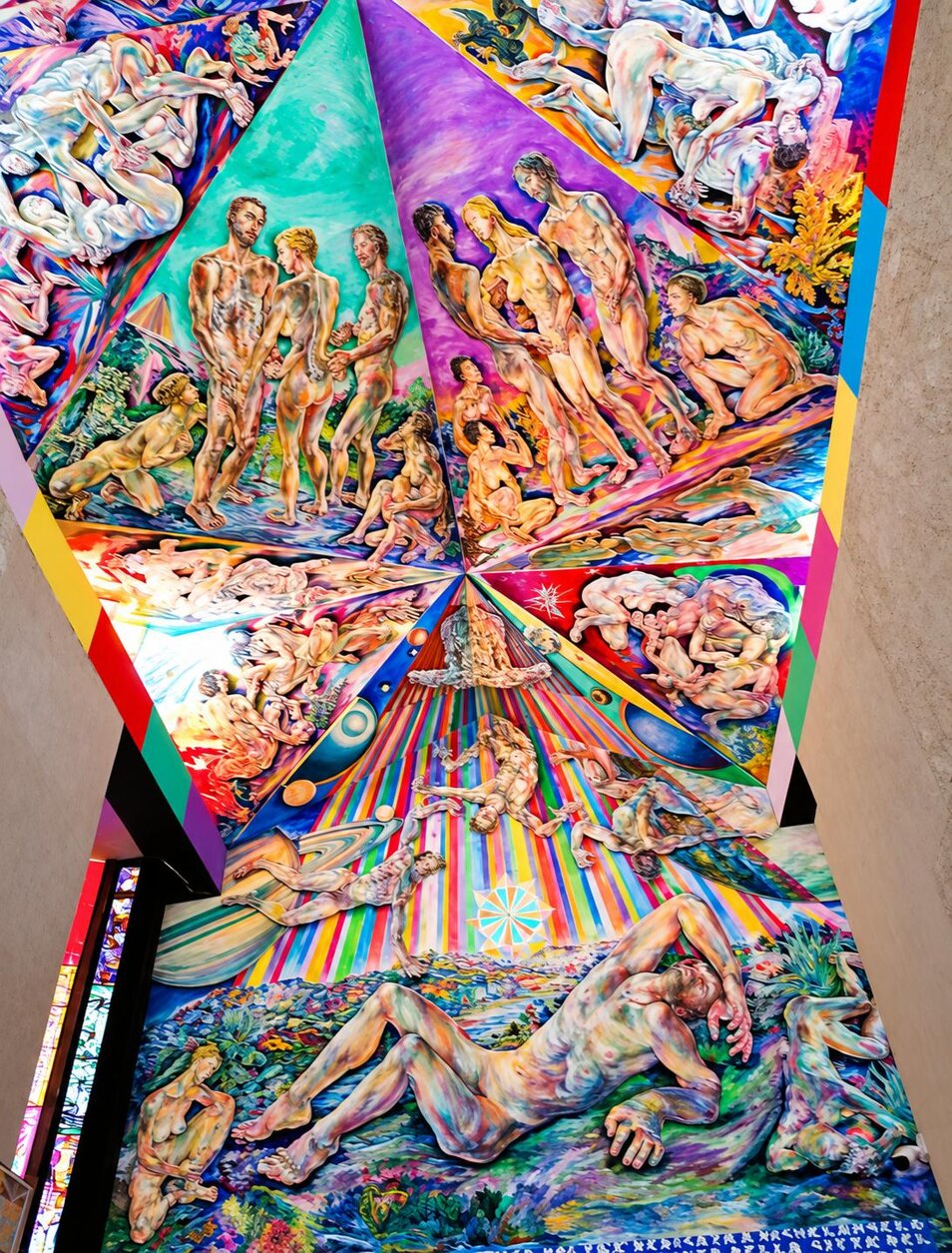
The most famous work of MuSaBa is located inside the ancient church of Santa Barbara. It is Jacob’s Dream, a gigantic three-dimensional work of about 240 square meters, often nicknamed the “Calabrian Sistine Chapel”. Spatari worked on it in the 1990s using a very particular technique. The figures are not simply painted on the surface: various shapes were cut out on lightweight supports, painted and placed in relief from the vault, creating a three-dimensional effect that changes depending on the point from which it is viewed. The figures thus seem suspended above the visitor and completely fill the space of the ancient church.
It is one of those places where photographs only partly convey the sense of the work’s scale.
The great mosaic of the guesthouse
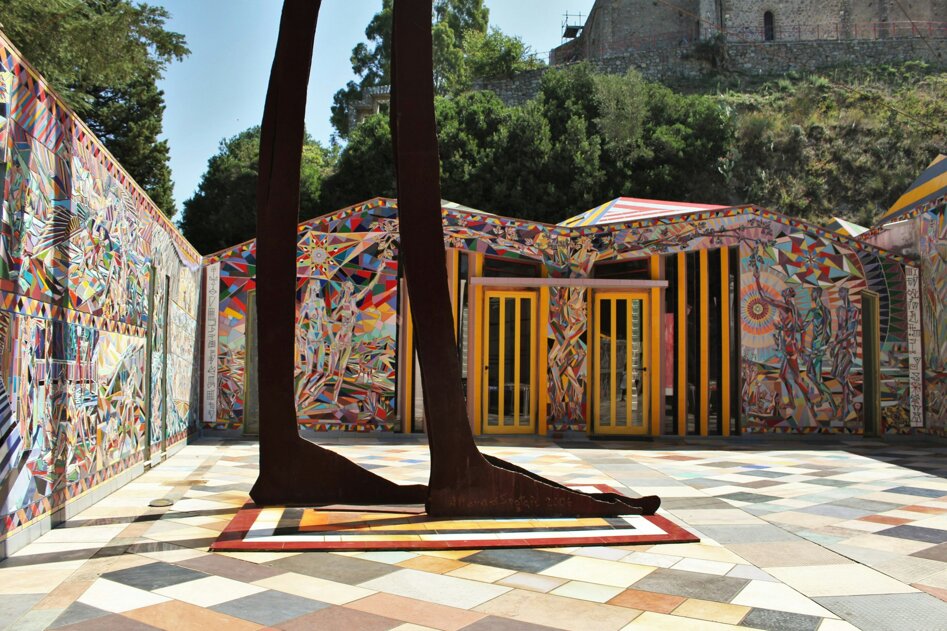
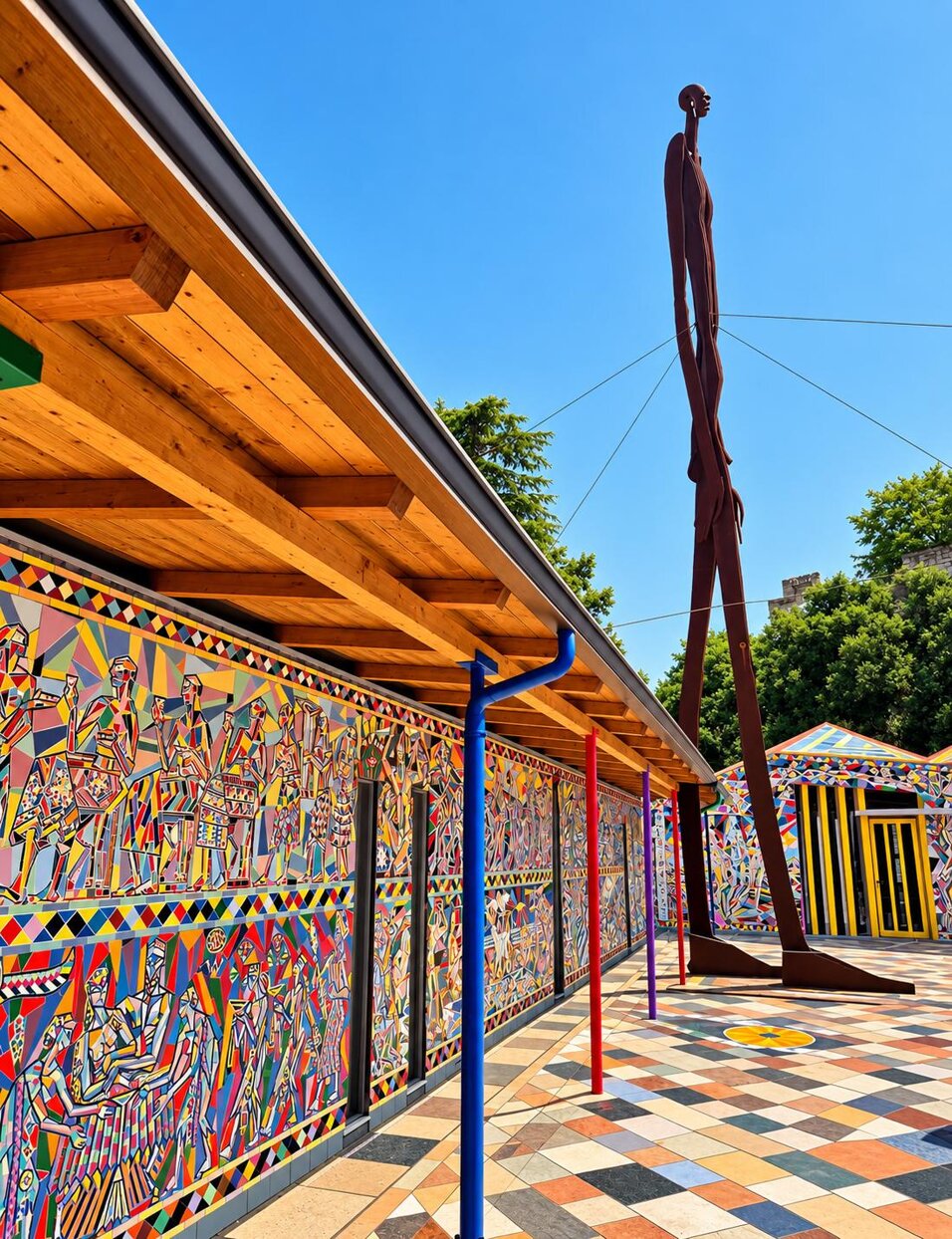
The other great star of MuSaBa is the Foresteria. Here, starting in 2006, Spatari created a huge monumental mosaic that totals about 1,400 square meters. The work continued until 2020, the year of the artist’s death. The walls are completely covered with tiles and colored fragments that form figures, geometries, and symbols.
The mosaic tells a kind of grand story of humankind: references appear to Sumerian civilization, ancient myths, the Old and New Testaments, and the themes that accompanied Spatari throughout his entire artistic output.
It is probably the place where the scale of the MuSaBa project is best understood. It is not, in fact, about decorating an already existing building: architecture and the artwork become one and the same.
The park and the outdoor works
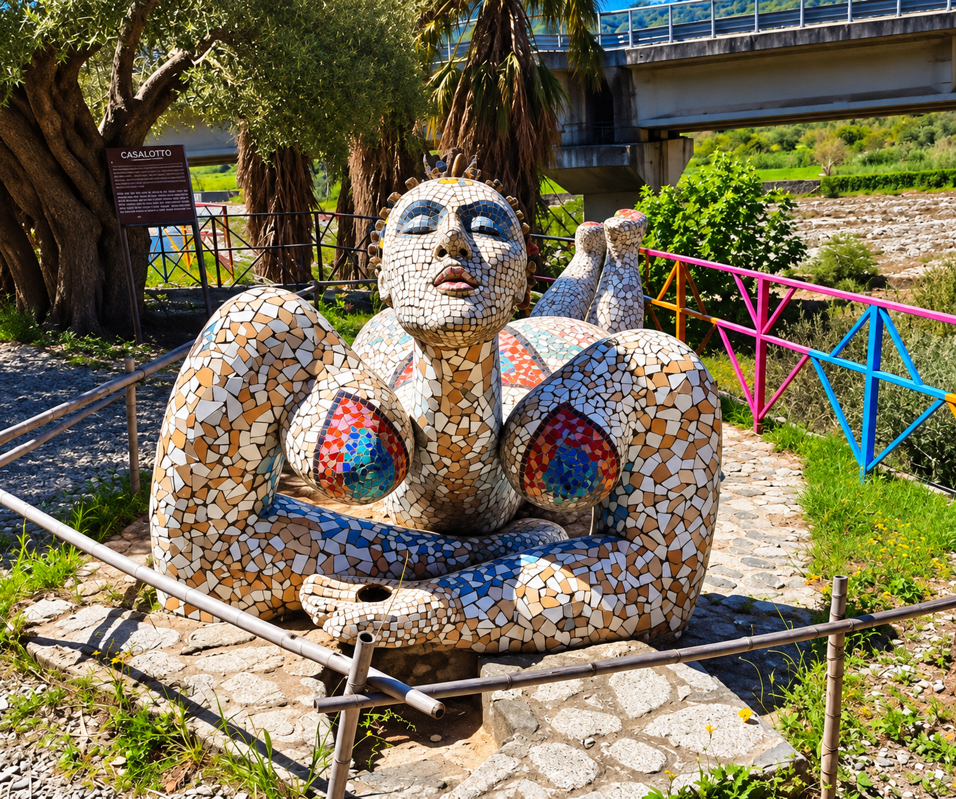
The visit continues outdoors. MuSaBa covers an area of about seven hectares and along the route you come across large sculptures, installations and architectural works set in the vegetation.
Some works are by Spatari, others were created by Italian and international artists who worked in the park. And it is precisely this open-air dimension that makes the experience unique: the landscape does not simply act as a backdrop, but becomes an integral part of the works.
MuSaBa was conceived from the outset as a permanent laboratory, a place meant to change over time and in which art is created directly within the territory.
Why visit MuSaBa
MuSaBa is one of those places you would hardly expect to come across while traveling through Calabria’s inland. And that is probably exactly its charm. In the middle of a valley at the foot of the Aspromonte, two artists spent more than half a century turning an abandoned complex into a huge open-air art workshop. You don’t necessarily need to be a contemporary art lover to appreciate it.
MuSaBa stands out above all for the size of the works, the colors, the contrast between old and new, and the constant relationship with the surrounding landscape. Between Jacob’s Dream, the gigantic mosaics of the Foresteria, and the installations scattered around the park, the visit is completely different from that of a traditional museum.
And that’s exactly why MuSaBa is worth a detour: it’s one of the most unusual and surprising places you can come across during a trip to Calabria.
In the surroundings
ROMAN VILLA OF CASIGNANA
GERACE
LOCRI EPIZEFIRI
ASPROMONTE
A visit to MuSaBa is a great chance to explore the inland area of the Locride and some of Calabria’s most charming villages. The first stop is naturally Mammola, with its distinctive old town of alleys and small squares, also known for stocco alla mammolese, a local culinary specialty. From here also starts the evocative Sentiero dei Greci, an ancient route that crosses the mountains toward the Tyrrhenian side.
Not far away, Gerace is well worth a visit, one of Calabria’s most beautiful villages, with its medieval historic center, the majestic Cathedral, and splendid views over the Ionian coast. Heading down to the sea you can reach Siderno, Marina di Gioiosa Ionica or Roccella Ionica, ideal for a stroll along the seafront or a few hours on the beach.
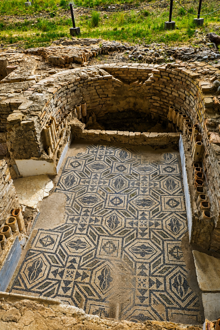
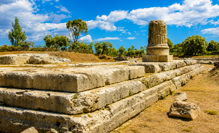
Also not to be missed is Locri, with the important archaeological area of ancient Locri Epizefiri, where you can discover traces of Magna Graecia, or a couple of km further south the beautiful Villa Romana di Casignana.
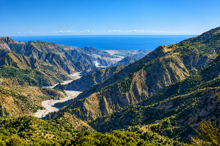
For mountain lovers, instead, the most natural choice is to explore the Aspromonte National Park.
Do you want to find out how to include this destination in your trip to Calabria?
Fill out the form: I will help you for free to build the right itinerary for you.
Looking for the perfect itinerary? Look here!