Fiery sunsets
Wonderful views

Let yourself be embraced by the warmth of Calabria, where every glance stirs emotion, every encounter feels like a hug, and beauty surprises you at every step.
CALABRIA
O N T H E R O A D
CALABRIA
RoadCalabria
O N T H E R O A D
Italy's most authentic region!
ROADCALABRIA
CONTACTS
EXPLORE
Ideas, itineraries and places to discover, to experience Calabria on the road
Follow us on Instagram
Sanctuary of Saint Francis of Paola: in the heart of Calabrian spirituality
Home
Itineraries
info@roadcalabria.it
Villages
What you’re looking for
CALABRIA
O N T H E R O A D
Beaches
Did you know that
Art, History, Culture
Useful Links
A solemn, mystical place, rich in history and art. A place of faith in the heart of Calabria
National Parks
Write to us
Trekking
Some of the images on RoadCalabria come from the 'Calabria Straordinaria' portal of the Calabria Region and are used under a CC-BY license
© 2026 RoadCalabria
Between faith, history and nature, the Sanctuary of Saint Francis of Paola preserves the places where the patron Saint of Calabria lived and where he founded the Order of Minims.
A few kilometers from the sea, on the first slopes of the inland area of Paola, there is a place where the landscape seems to change suddenly. The noise of the town gives way to greenery, to the waters of the Isca stream and to the silence of a religious complex that for centuries has drawn pilgrims from all over Italy and beyond.
It is the Sanctuary of Saint Francis of Paola, one of the most important places of worship in Calabria and the main center of devotion to the Saint born in Paola in 1416.
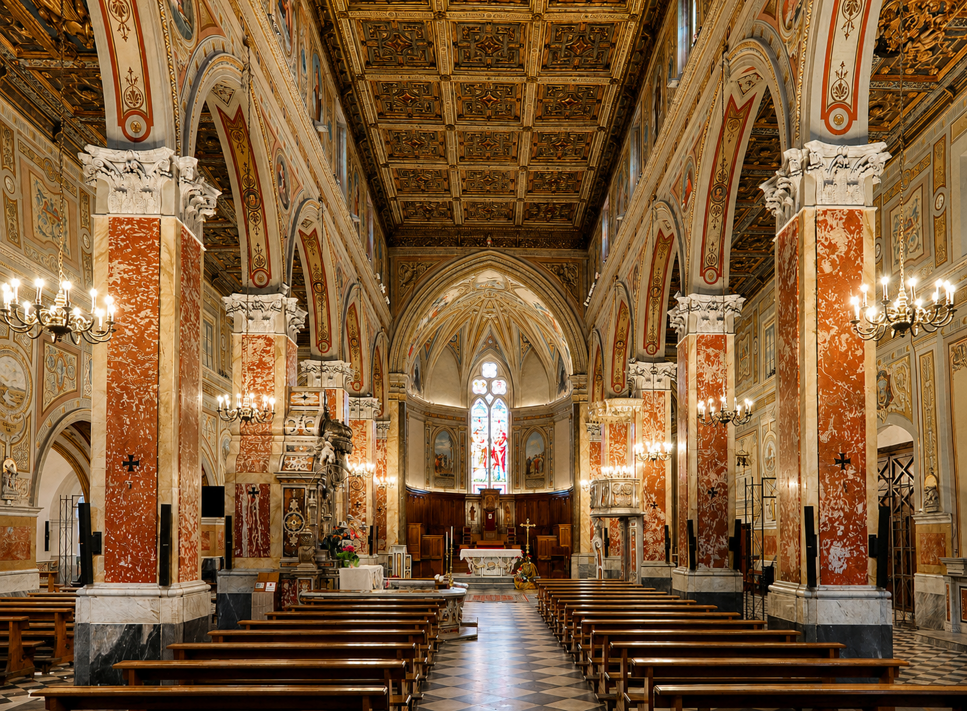
It is not simply a church. The Sanctuary is a true journey through Francis’s life: here you will find the ancient hermitage, his cell, the convent, the basilica, the modern liturgical hall and some of the places that tradition links to the Saint’s best-known miracles.
Who was Francis of Paola
Francis of Paola was born in Paola in 1416 and, while still very young, chose a life radically different from that of his contemporaries.
After a period spent in a convent and a pilgrimage made with his family, he withdrew as a hermit in the surroundings of his hometown. Prayer, fasting, penance, poverty and contemplation became the central elements of his existence.
The fame of the young hermit, however, began to spread rapidly. More and more people reached Paola to meet him, ask advice or entrust themselves to his prayers, while some men decided to share his same spiritual experience.
From that small community there gradually arose the religious order that would become the Order of Minims. In 1470 the hermitage of Paola obtained a first ecclesiastical recognition and in 1474 Pope Sixtus IV approved the eremitical congregation. The Order of Minims would later obtain the approval of the Holy See in its definitive form.
Francis's fame reached as far as the French court. In 1483, by the will of Pope Sixtus IV and at the request of King Louis XI of France, he left Calabria and reached France.
He would never return to his Paola. He died in Tours on 2 April 1507 and was canonized in 1519, only twelve years after his death. In 1943 Pope Pius XII also proclaimed him patron of Italian seafarers, a particularly meaningful link for a Saint born on the Calabrian coasts.
Where the Sanctuary is located
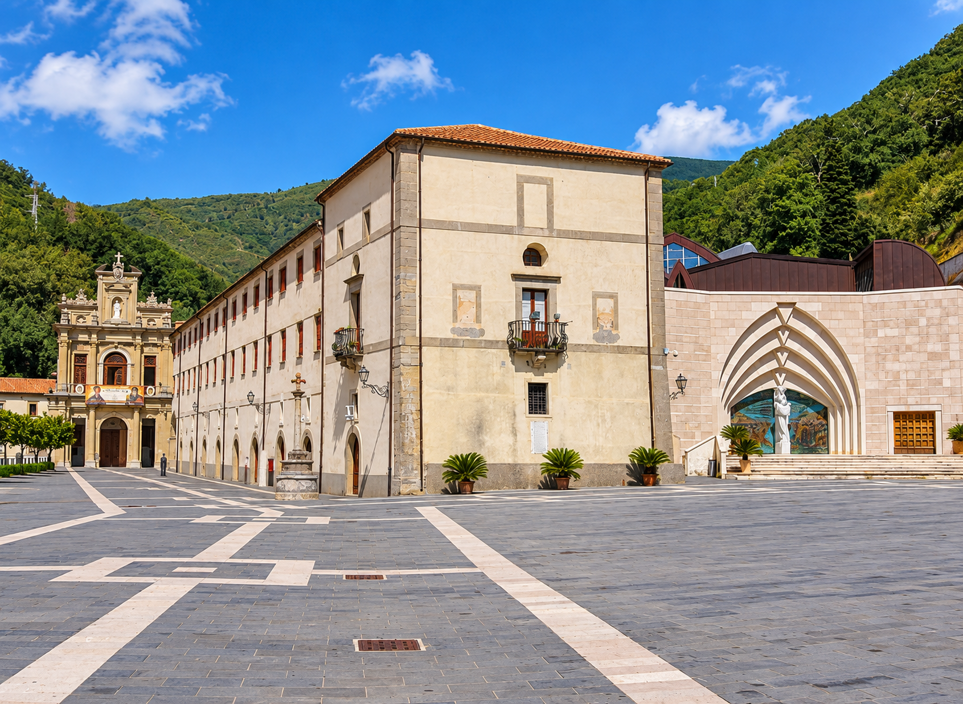
The Sanctuary stands in the upper part of Paola, in the province of Cosenza, in a setting completely different from that of the Tyrrhenian coast lying just a little lower down.
The complex stretches along the valley carved by the Isca stream, surrounded by vegetation and mountain slopes.
It is precisely this location that adds to the charm of the place. The Sanctuary does not appear as an isolated monument, but as a group of buildings, paths, caves, bridges and prayer spaces that gradually grew around the places chosen by Francis for his hermit life.
From the Hermitage to the great Basilica
The history of the Sanctuary begins in the 15th century.
Around 1436 a small oratory was built on the left bank of the Isca, about sixty meters from the cave where Francis had lived. It was an extremely simple space: just over twelve meters long, a barrel vault, small windows and an altar.
Next to the oratory, some cells were made for the hermit's first companions. This is the original core from which the community of the Minims would take shape.
As followers and the faithful increased, that space soon became insufficient.
Around 1452 Francis therefore began building a real church, initially dedicated to Saint Francis of Assisi. Between 1469 and 1474 the building was further enlarged, giving rise to the historic core of the Basilica that is still part of the Sanctuary today.
What to see in the Sanctuary
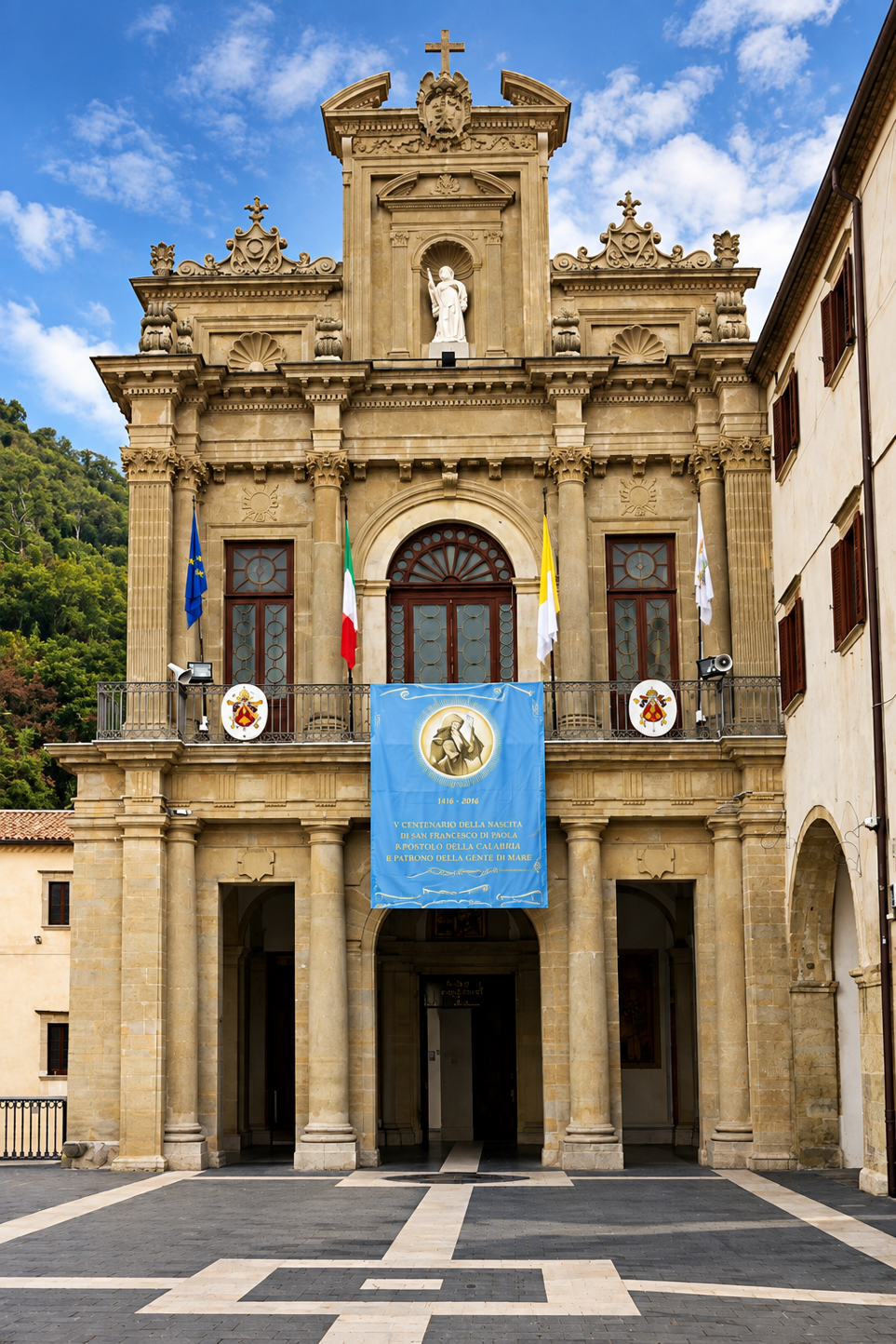
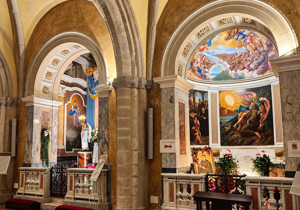
Visiting the Sanctuary means passing through buildings from very different periods, yet united by the figure of Saint Francis.
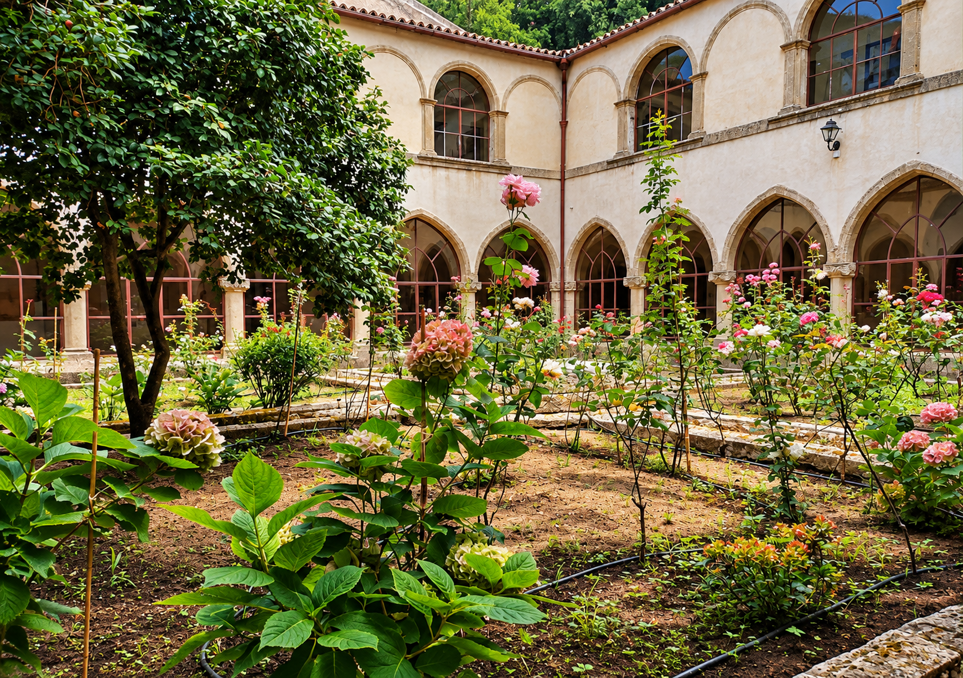
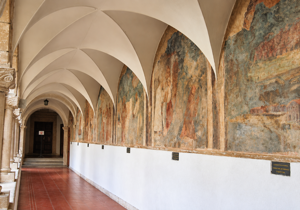
The historic heart is the Basilica, the convent and the ancient hermitage. Especially evocative is the cloister, along which artistic and religious testimonies linked to the history of the Order are preserved.
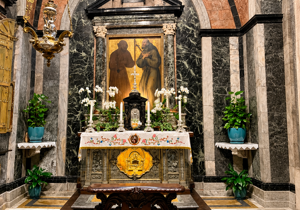
Within the convent area there is also the Saint’s Cell, used by Francis until his departure for France in 1483. After canonization it was turned into a chapel and still preserves depictions of some miracles attributed to the Saint.
The visit therefore allows you to move from monumental settings to very small and austere spaces, perhaps those that best convey Francis’s original eremitic choice.
The new liturgical hall
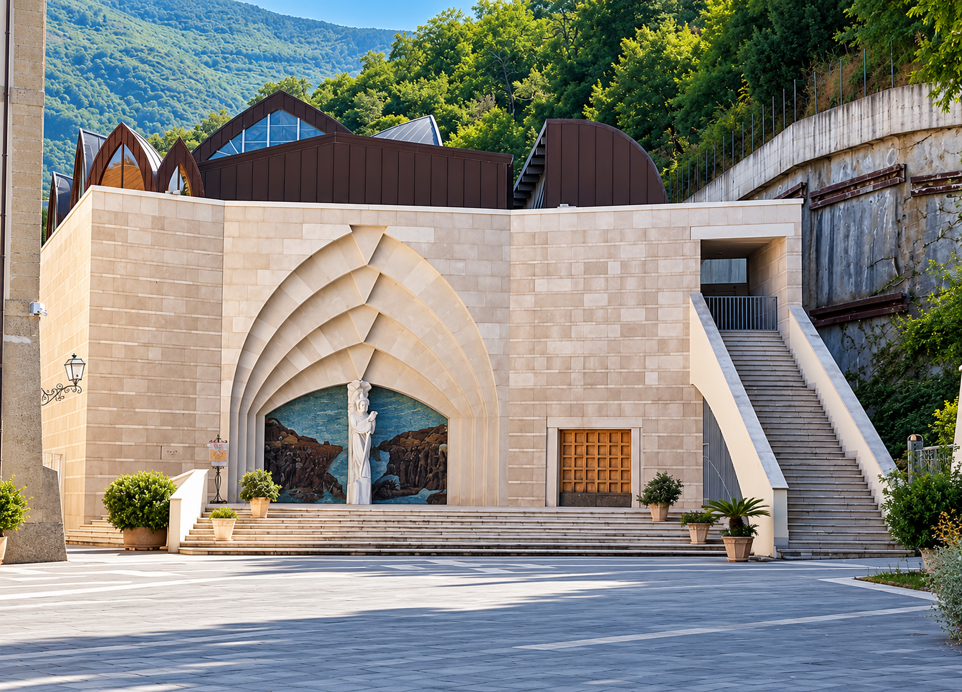
Next to the ancient buildings, the presence of the new liturgical hall is striking: a large contemporary church designed by architect Sandro Benedetti.
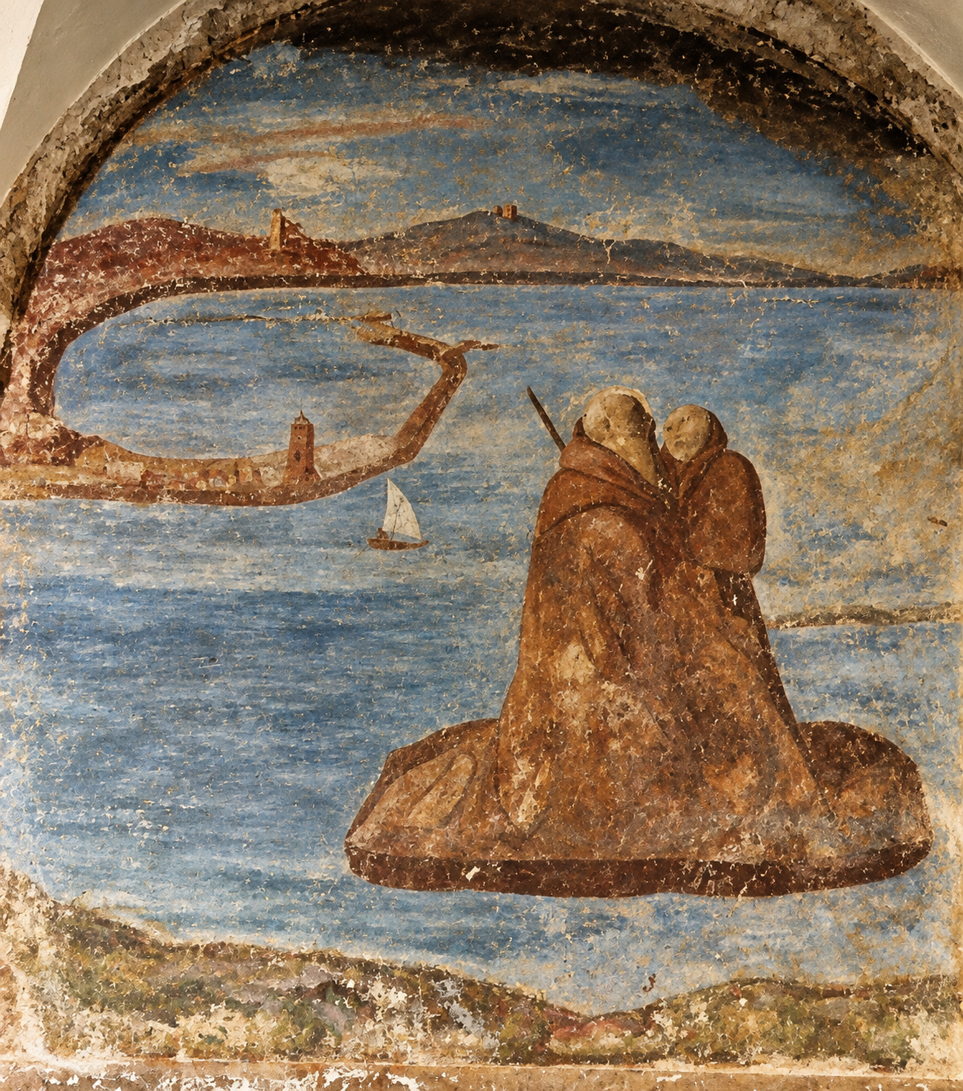
Its architecture is strongly symbolic. The structure is partly set into the ground, almost evoking the caves and Francis’s eremitic life, while the roofs recall the sails of a ship. The reference is to the famous tradition according to which the Saint miraculously crossed the Strait of Messina using his cloak as a sail.
Earth, water and fire recur in the building’s architecture and also in the large bronze portal.
At the center of the entrance, a marble statue depicts Saint Francis in the act of welcoming pilgrims, accompanied by the word that perhaps best sums up his spiritual message: CHARITAS.
The “miracle zone”
One of the most distinctive parts of the Sanctuary lies between the historic Basilica and the new church.
It is known as the Miracles Area and brings together some places that tradition links to the wondrous episodes in Francis’s life.
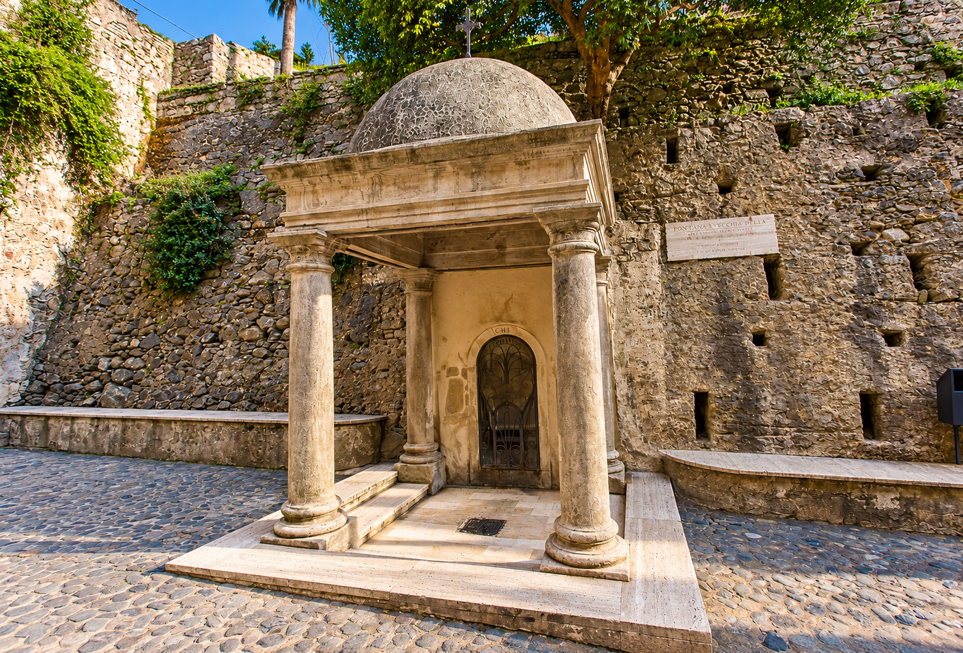
Here you find the kiln, used during the construction of the convent, the Fonte della Cucchiarella, a spring that, according to tradition, is said to have gushed forth through the Saint’s intervention, and the evocative Devil’s Bridge, which crosses the Isca stream.
In the same area there is also a bomb that remained unexploded during the Second World War, an event later linked to the Saint’s protection.
Regardless of the visitor’s personal faith, it is a key part of the route because it helps you understand how deeply the figure of Saint Francis is intertwined with the popular memory of Paola and Calabria.
A pilgrimage site in the heart of Calabria
Even today the Sanctuary remains one of the region’s main religious destinations.
Saint Francis is a figure deeply felt by Calabrians, and devotion to him goes far beyond the borders of Paola. The Sanctuary is the place where this devotion finds its most intense expression: pilgrims, religious groups and simple visitors arrive throughout the year to walk the same places linked to the Saint’s life.
The most important moment is naturally that of the celebrations dedicated to Saint Francis of Paola, whose liturgical memorial falls on 2 April, the day of his death.
But the Sanctuary is not interesting only for those who come there on pilgrimage.
One of the finest features of the Sanctuary of Paola is precisely its ability to be at the same time a religious place, historic monument and nature-immersed space.
The sound of the Isca’s water accompanies part of the route. The ancient buildings seem almost to blend with the rock and the vegetation, while caves, bridges and small rooms constantly recall that it all began not from a great basilica, but from the choice of a young Calabrian to withdraw into solitude.
Then came the first disciples. Then the pilgrims. And finally a religious complex known well beyond Calabria’s borders.
^^^^^^^^^
Look here…
MOST BEAUTIFUL VILLAGES IN CALABRIA
CALABRIA ITINERARIES
NATIONAL PARKS
TREKKING
Are you interested in places of faith and traditions?